Can Distance Education Students Pursue LLB & Join the Bar?
Are Distance Education students eligible for LLB admission in AP/TG?
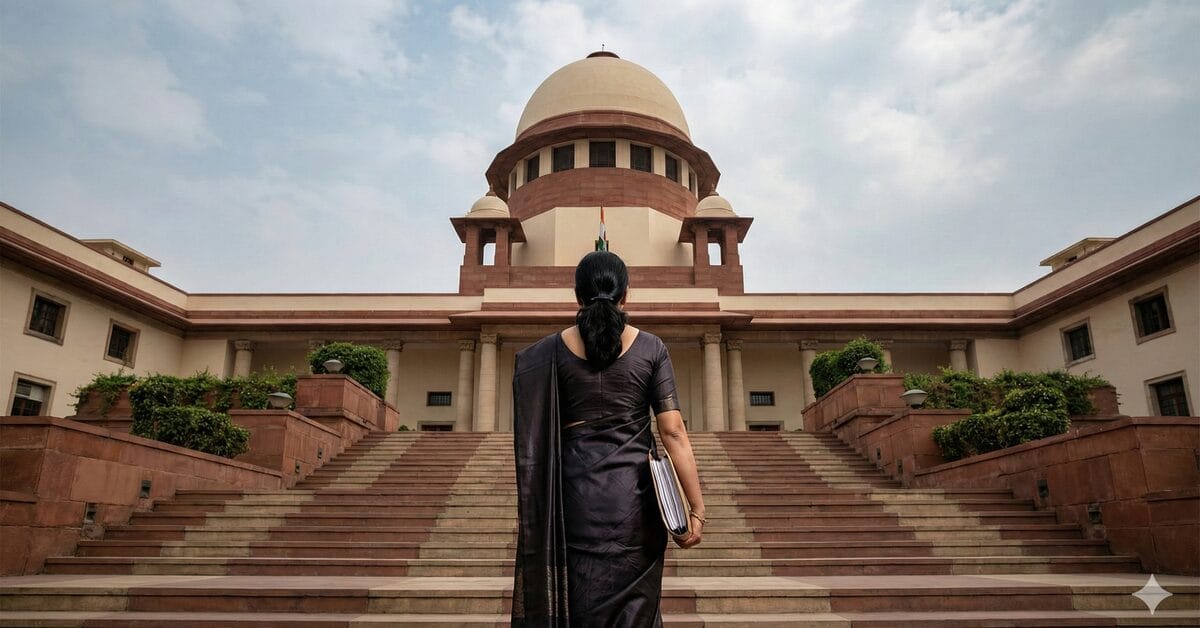
She Fought All The Way to the Supreme Court So You Don't Have To — The STS Gladies Case and What It Means for Distance Education Graduates
If you completed 10+2 and then did your graduation through distance mode — you are NOT disqualified from becoming an advocate. The law always permitted it. The Bar Council of Telangana simply refused to follow it. One woman fought back. This is her story, and this is your roadmap.
The Question That Haunts Thousands of Telugu Students Interested in Law
You finished school (10+2). You did your degree through IGNOU, or Kakatiya Distance, or Osmania Distance, or Dr. BR Ambedkar Open University. You then joined a BCI-approved law college. You completed LLB. You passed AIBE.
Now you go to the Bar Council of Telangana to enrol as an advocate.
And they say: "Sorry. Your graduation was through distance mode. You cannot become an advocate."
This is not a hypothetical. This has happened to hundreds of students in Telangana over the past five years. Some gave up. Some moved to other states where their degrees were accepted.
One woman refused to accept it.
Her name is STS Gladies. And her case is now before the Supreme Court of India.
Who Is STS Gladies?
STS Gladies is a 45-year-old woman from Telangana. She completed her Bachelor of Arts through correspondence from Kakatiya University between 2009 and 2012.
She then completed a regular LLB degree from a BCI-approved college.
She passed the All India Bar Examination (AIBE).
She applied for enrolment with the Bar Council of Telangana.
They rejected her.
The reason? Her undergraduate degree was obtained through correspondence mode.
Not her LLB. Her BA.
Let that sink in.
What Did the Telangana High Court Say?
Gladies filed Writ Petition No. 27799 of 2024 in the Telangana High Court.
On 21 October 2024, Justice B. Vijaysen Reddy dismissed her petition.
The entire judgment is three paragraphs. Here is the core:
"As the matter is squarely covered by the decision of the Division Bench of this Court in Naveen Kumar's case (Supra 1), Katroth Pradeep Rathod's case (Supra 2) and the judgment of this Court in W.P.No.13037 of 2024 dated 14.10.2024, the writ petition is dismissed."
No independent analysis. No examination of the BCI Rules. No engagement with the proviso to Rule 5.
Just: "We already decided this. Case closed."
What Did Gladies Do Next?
She did not give up.
She filed Special Leave Petition (Civil) No. 30217 of 2024 before the Supreme Court of India.
On 16 December 2024, a bench comprising Justice Vikram Nath and Justice PB Varale issued notice to the Bar Council of India and the Bar Council of Telangana.
The Supreme Court admitted the case.
This means the highest court in India will now decide — for the first time — whether distance education graduates can be systematically denied enrolment as advocates.
The case is currently still pending.
What Does the Law Actually Say?
Since we at 1516 are always about analysing the details, we found many important points. This is where it gets interesting. Because the law is not ambiguous. The Bar Council's own rules permit exactly what Gladies did.
Rule 5 of the BCI Rules of Legal Education, 2008
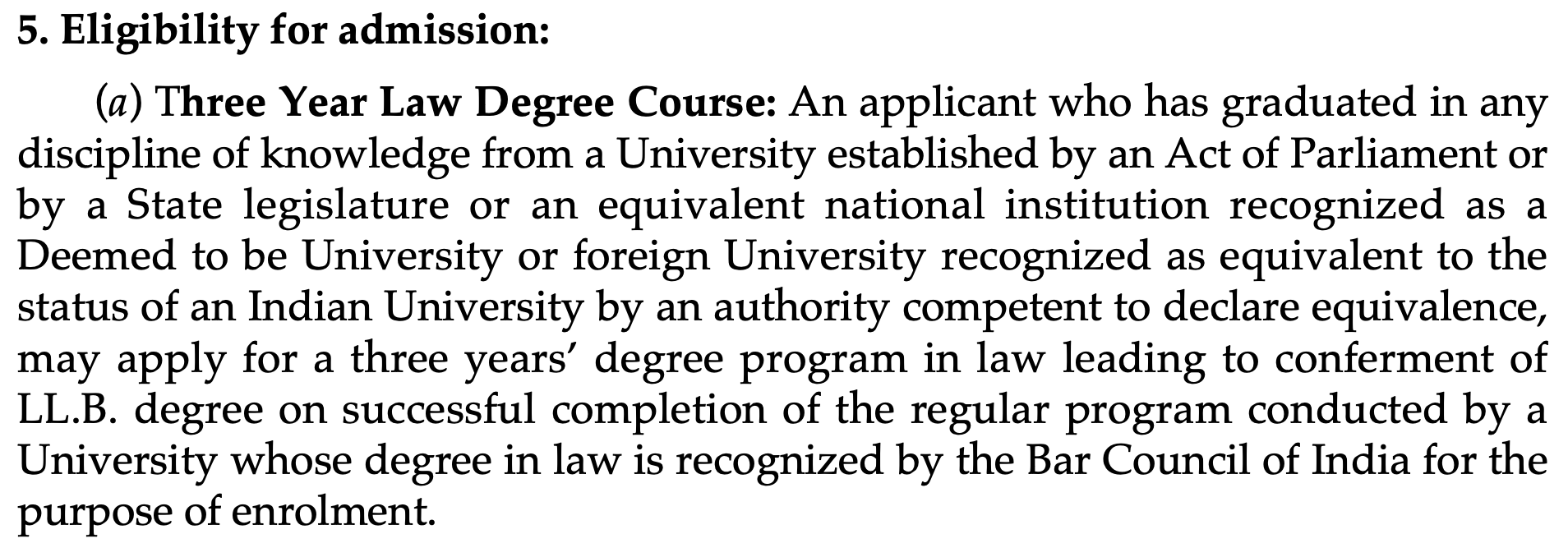
Rule 5(a) — For the 3-year LLB course:
"An applicant who has graduated in any discipline... from a University established by an Act of Parliament or by a State Legislature... shall be eligible for admission."
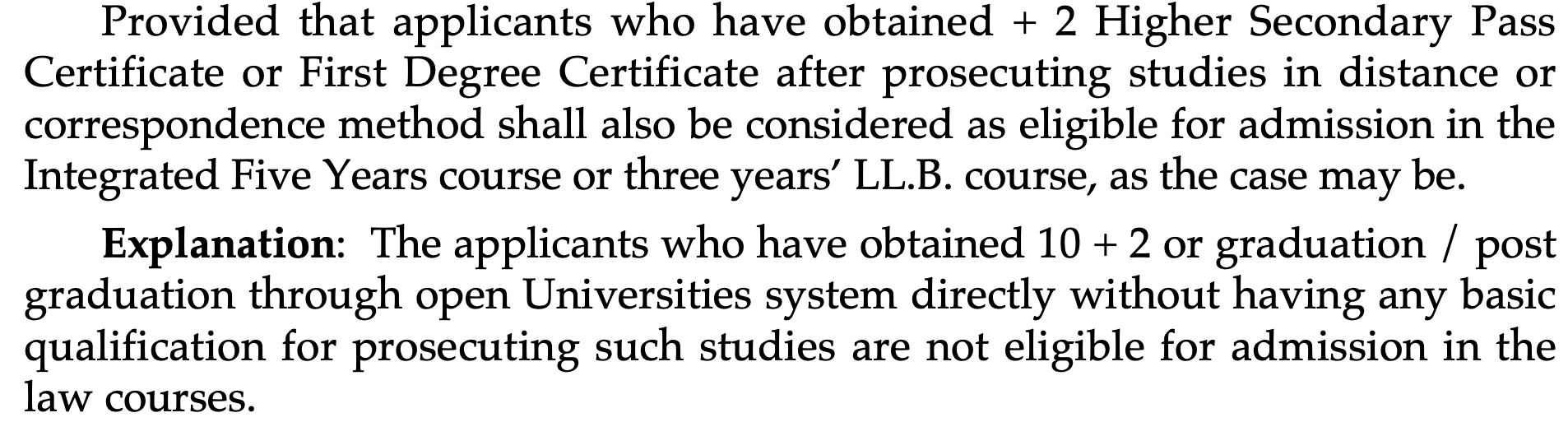
The Proviso to Rule 5:
"Provided that applicants who have obtained +2 Higher Secondary Pass Certificate or First Degree Certificate after prosecuting studies in distance or correspondence method shall also be considered as eligible for admission in the Integrated Five Years course or three years' LL.B. course, as the case may be."
Read that again.
The proviso explicitly states that distance or correspondence mode is permitted for both:
- Your +2 qualification, AND
- Your first degree (graduation)
The Explanation to Rule 5:
"The applicants who have obtained 10+2 or graduation/post graduation through open Universities system directly without having any basic qualification for prosecuting such studies are not eligible."
The key phrase is "without basic qualification." So we began to dig deeper into what that means.
What Does “Basic Qualification” Mean Under Rule 5 (BCI Legal Education Rules, 2008)?
This section clarifies only one issue:
What exactly is meant by “basic qualification” under Rule 5, and how distance / open education fits into it.
The Core Rule (Rule 5)
For the 3-Year LL.B.
- You must have:
- 12th (+2), followed by
- A 3-year graduation degree
- The LL.B. itself must be regular (law cannot be through distance mode).
For the 5-Year Integrated LL.B.
- You must have:
- 10th, followed by
- 12th (+2)
The Proviso — Distance / Correspondence Education Is Allowed
Rule 5 contains a clear proviso:
Candidates who obtained +2 or Graduation through distance or correspondence mode are eligible for admission to:
- 5-year integrated LL.B., or
- 3-year LL.B., as applicable.
So, distance education by itself is not a disqualification.
The Explanation — Where Confusion Originally Arose
The explanation to Rule 5 disqualifies only one category:
Candidates who entered open universities directly without any basic qualification are not eligible.
This targets “direct entry” cases, typically:
- No 10th
- No 12th
- Admission based only on age or experience
It does not disqualify normal students who followed the standard academic ladder.
What did BCI Clarify in 2011 & 2017?
This section answers one narrow but critical question:
What is the “basic qualification” under Rule 5 of the BCI Legal Education Rules, 2008, and does distance / open education affect eligibility?
The answer is now conclusively settled by:
- The Legal Education Committee clarification (April 2011), and
- The official Bar Council of India clarification (April 2017) published on the BCI website.
The Statutory Rule (Rule 5)
For the 3-Year LL.B.
- Required academic sequence:
- 12th (+2) → 3-year Graduation → Regular LL.B.
For the 5-Year Integrated LL.B.
- Required academic sequence:
- 10th → 12th (+2) → 5-Year Integrated LL.B.
(The law degree itself must be regular.)
The sequence must be followed, some people do Graduation and later do +2, such candidates are not eligible. If you are wondering how it is possible, it is possible because people who went for such a graduation did not require any basic qualification. The degree allowed it. Such programs are rare nowadays.
The Proviso — Distance / Correspondence Is Permitted
Rule 5 expressly provides that candidates who obtained:
- +2, or
- Graduation
through distance / correspondence mode
shall be considered eligible for admission into law courses.
Distance education is therefore not a disqualification.
The Explanation — What Is Prohibited
The explanation to Rule 5 disqualifies only one category:
Candidates who obtained qualifications through direct entry without any basic qualification.
This targets:
- Age-based entry
- Skipping 10th or 12th entirely
It does not target the mode of education.
Context: In the past, Mysore University used to offer a degree program and the only qualification to get a degree from there was that you were required to be age 25 or above. Such degrees are outlawed now and do not exist.
2011 Clarification — Why It Was Issued
In April 2011, the Legal Education Committee clarified Rule 5 which was regressive. It said that "basic qualification" cannot be from open university system. Whether they meant NIOS/APOSS/TOSS is not clear from this. But fortunately, we have a 2017 clarification below.
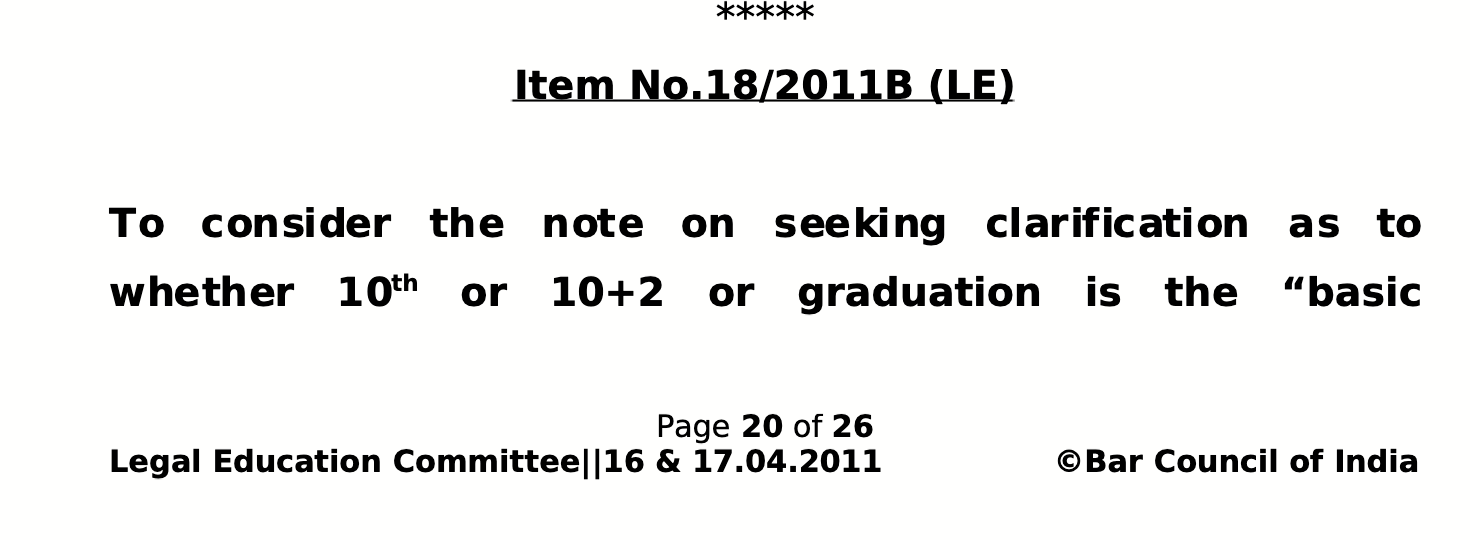
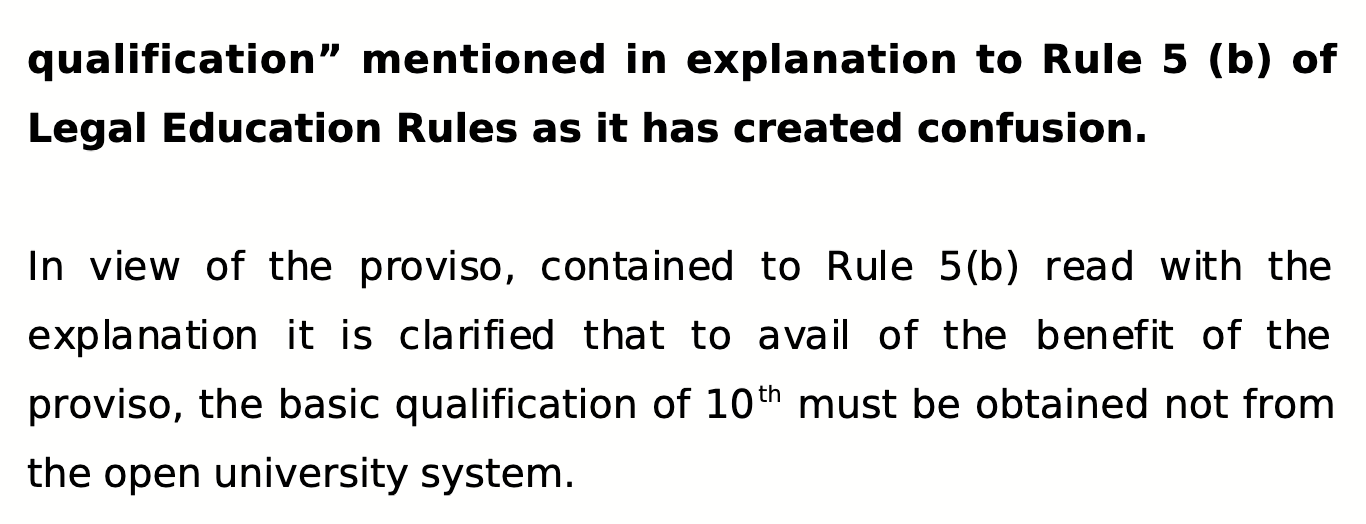
2017 Official BCI Clarification — The Settled Position
In April 2017, the Bar Council of India published an official clarification stating:
- For 5-Year LL.B.:
- Basic qualification: 10th
- Must be followed by 12th
- For 3-Year LL.B.:
- Basic qualification: 12th (+2)
- Must be followed by graduation
BCI further clarified that:
The qualifications of 10th, 12th, and graduation may be obtained through any mode — regular, distance, correspondence, or open schooling — provided the academic sequence is not broken.
This clarification is official, public, and binding. This means that those students who opted for NIOS, APOSS or TOSS are also eligible for enrolment into LLB programs.
Correct Eligibility Matrix (Post-2017)
| Academic Path | Eligible |
|---|---|
| 10th open/private → 12th open/distance → Graduation distance → Regular LL.B. | YES |
| 10th open/private → 12th regular → Graduation distance → Regular LL.B. | YES |
| 10th regular → 12th regular → Graduation regular → LL.B. | YES |
| No 10th → Direct open university graduation → LL.B. | NO |
| Skipping 12th and entering graduation via age | NO |
The One-Line Rule
- 5-Year LL.B.: Basic qualification = 10th
- 3-Year LL.B.: Basic qualification = 12th
- Mode of education does not matter - REGULAR/OPEN/PRIVATE
- Skipping foundational stages does
This is the final and settled interpretation under Rule 5, as clarified in 2011 and authoritatively reaffirmed by BCI in 2017.
The Two Types of Distance Education — Why This Distinction Matters
There are two fundamentally different categories being conflated:
Type 1: Valid Distance Education
- You completed 10th standard from a recognised board (CBSE, ICSE, State Board)
- You completed 12th standard (or equivalent)
- You then pursued graduation through distance/correspondence mode from a UGC-recognised university
- You then pursued regular LLB from a BCI-approved college
This is valid. The BCI rules explicitly permit this.
Type 2: Invalid Distance Education
- You never completed 10th standard in regular mode
- You directly enrolled in an open university at age 25+ without proper foundational qualifications
- You obtained graduation without ever passing school education
This type of degree is NOT permitted to enrol in either LLB or in BCI.
The tragedy is that courts have been collapsing both categories into one — and rejecting everyone with any distance education in their history.
The Madras High Court Full Bench Judgment — Where It All Went Wrong
In 2018, a Full Bench of the Madras High Court decided G.S. Jagadeesh v. Chairman, Tamil Nadu Dr. Ambedkar Law University.
That case involved a candidate who had studied only until Class 8 in regular mode. He then appeared for Class 10 and 12 as a private candidate and did graduation.
The Full Bench held that such a candidate — who bypassed proper schooling — was not eligible. Though this does not make sense keeping in view the 2017 clarification by BCI.
The problem?
Courts in Telangana started applying this judgment to ALL distance education graduates — including those who completed full schooling and only did graduation through distance mode.
This is a misapplication of the law.
The Full Bench itself was clear:
"A candidate cannot be excluded on the mere ground that he appeared for the Higher Secondary Course Examination as a private candidate without attending regular school or a correspondence course."
But this nuance was lost in translation. I am guessing the counsels appearing did not understand this nuance as well and could not guide the court correctly.
The BCI Clarification Letter — December 2025
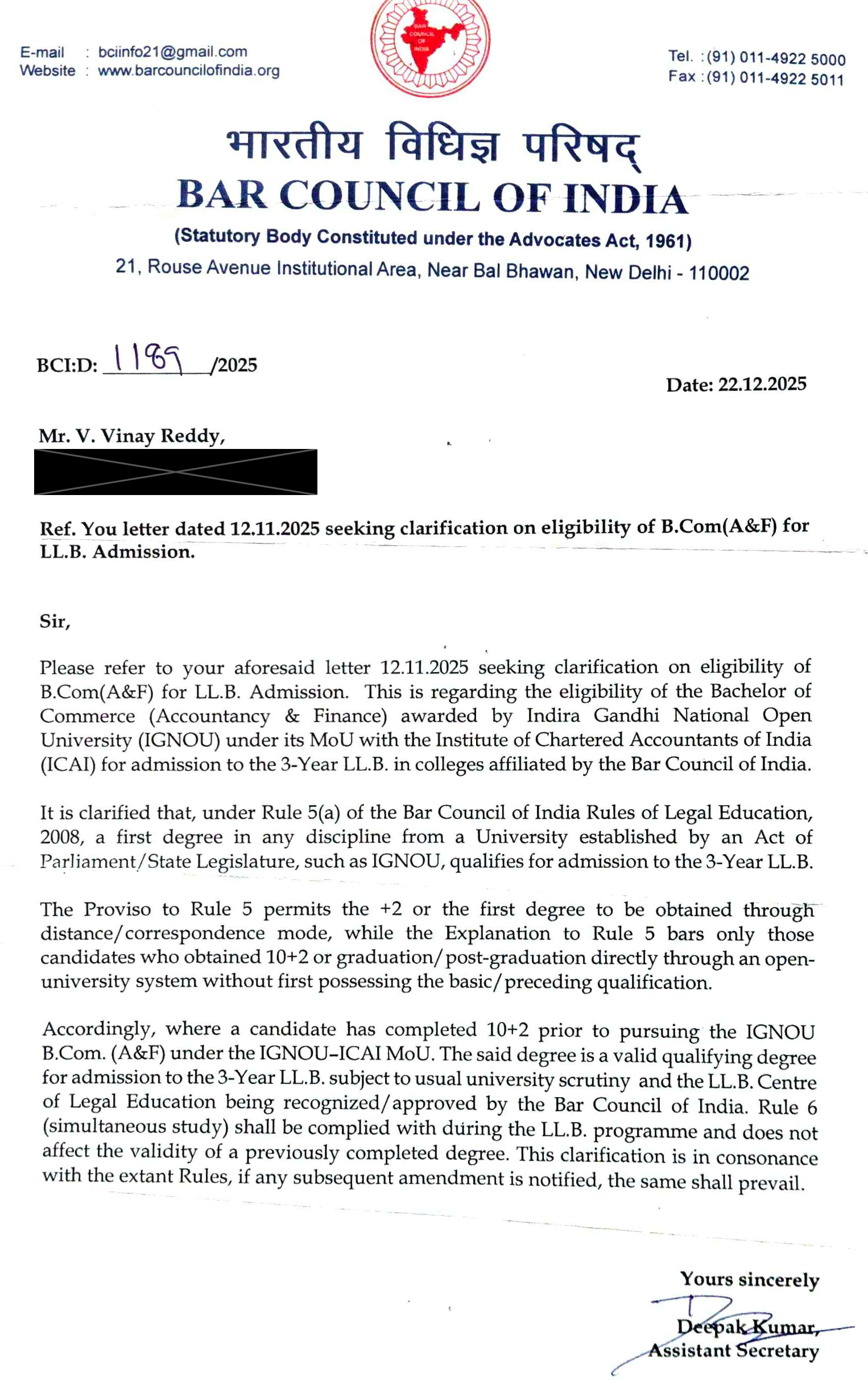
On 22 December 2025, the Bar Council of India issued a written clarification in response to a query from 1516 community member Vinay Reddy about the IGNOU B.Com (Accountancy & Finance) degree and its eligibility for LLB enrolment.
Reference: BCI:D: 1189/2025
The clarification states:
"It is clarified that, under Rule 5(a) of the Bar Council of India Rules of Legal Education, 2008, a first degree in any discipline from a University established by an Act of Parliament/State Legislature, such as IGNOU, qualifies for admission to the 3-Year LL.B."
"The Proviso to Rule 5 permits the +2 or the first degree to be obtained through distance/correspondence mode, while the Explanation to Rule 5 bars only those candidates who obtained 10+2 or graduation/post-graduation directly through an open university system without first possessing the basic/preceding qualification."
"Accordingly, where a candidate has completed 10+2 prior to pursuing the IGNOU B.Com. (A&F) under the IGNOU-ICAI MoU, the said degree is a valid qualifying degree for admission to the 3-Year LL.B."
This is in writing. From the Bar Council of India. Dated December 2025. Download Copy here.
The Position Is Now Unambiguous
Let me state it plainly so there is no confusion:
If you:
- Completed 10+2 from a recognised board (any mode — regular, private candidate, NIOS, open school — as long as you had the proper preceding qualification), AND
- Completed graduation through distance/correspondence mode from a UGC-recognised university, AND
- Completed LLB from a BCI-approved college in regular mode
Then:
- You are eligible for LLB admission ✓
- You are eligible for Bar Council enrolment ✓
- You are eligible to practice as an advocate ✓
No State Bar Council can deny you enrolment on the ground that your graduation was through distance mode.
If they do, they are violating the BCI's own rules and the recent clarification.
What Should You Do If You Face Rejection?
Step 1: Gather Your Documents
- Your 10th standard marksheet and certificate
- Your 12th standard marksheet and certificate
- Your graduation degree and marksheets (even if distance)
- Your LLB degree
- Your AIBE certificate
- The BCI clarification letter dated 22.12.2025 (attach a copy)
Step 2: Apply Formally
Submit your enrolment application with all documents. Get an acknowledgment.
Step 3: If Rejected — Get It in Writing
Insist on a written rejection order stating the specific ground of rejection. This is your evidence for litigation.
Step 4: Cite the Correct Legal Position
In any representation or appeal, cite:
- Rule 5(a) of BCI Rules of Legal Education, 2008
- The Proviso to Rule 5
- The Explanation to Rule 5 (emphasising "without basic qualification")
- BCI 2017 Clarification
- BCI Clarification dated 22.12.2025
- STS Gladies v. Bar Council of India (SLP(C) No. 30217/2024) — pending before Supreme Court though BCI Advocate already confirmed that she is eligible for enrolment.
Step 5: If Necessary — Litigate
File a writ petition in the High Court. The statement made by BCI Advocate in STS Gladies case in the Supreme Court strengthens your position significantly.
What About the IGNOU-ICAI B.Com (A&F)?
Many Chartered Accountancy students earn a B.Com (Accountancy & Finance) degree through a Memorandum of Understanding between IGNOU and ICAI.
Over 48,000 students have completed this degree.
The BCI clarification letter of December 2025 specifically addresses this degree and confirms:
"Where a candidate has completed 10+2 prior to pursuing the IGNOU B.Com (A&F) under the IGNOU-ICAI MoU, the said degree is a valid qualifying degree for admission to the 3-Year LL.B."
If you are a CA with an IGNOU B.Com (A&F) and completed regular 10+2 before that — you are eligible for LLB and Bar enrolment.
This letter actually clarifies more than only the position on IGNOU, it clarifies that all distance education Graduation courses are valid provided a student has 'basic qualification' and the LLB itself is not distance education.
Why This Matters Beyond Individual Cases
At 1516, we are fervent advocates of Distance learning. Distance education exists because not everyone has the privilege of attending regular college.
Working professionals. Women with family responsibilities. Students in rural areas without access to quality colleges. Financially constrained families. Government employees etc.
These people chose distance education not because they wanted shortcuts — but because it was the only path available to them.
The law recognised this. A distance education degree is fully valid as per UGC and DEB. Distance education holders are eligible for Govt jobs also. The BCI rules explicitly accommodate this.
When State Bar Councils deny enrolment to such candidates — they are not enforcing the rules. They are adding requirements that don't exist.
Disclaimer
1516's view and this article are only interpretations of the rules based on an understanding of the English language by the author. This article does not constitute legal advice, consult a legal professional to get help if you need it.
1516 exists to make the distinction impossible to ignore. We create awareness for Telugu students.
TL;DR
The Rule That Protects You
Proviso to Rule 5, BCI Rules of Legal Education, 2008:
"Applicants who have obtained +2 Higher Secondary Pass Certificate or First Degree Certificate after prosecuting studies in distance or correspondence method shall also be considered as eligible for admission in the Integrated Five Years course or three years' LL.B. course, as the case may be."
The Clarification That Confirms It
BCI Letter dated 22.12.2025 (BCI:D: 1189/2025):
"The Proviso to Rule 5 permits the +2 or the first degree to be obtained through distance/correspondence mode, while the Explanation to Rule 5 bars only those candidates who obtained 10+2 or graduation/post-graduation directly through an open university system without first possessing the basic/preceding qualification."
This article will be updated when the Supreme Court delivers its judgment on STS Gladies though her enrolment matter has already been cleared by the advocate representing BCI.
Prithvi Raj Kunapareddi is the Founder of 1516.